- Highlights of 12th ISUW 2026


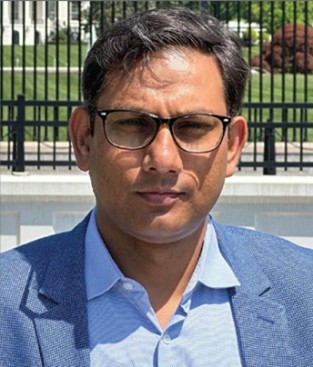
Dy Advisor - Energy,
NITI Aayog
Manoj Kumar Upadhyay is an energy policy professional with over 15 years of experience across India’s power sector. He began his career in the private sector as a project and product design manager in multinational companies, before joining the Government of India in 2010 as assistant director in the Ministry of Micro, Small and Medium Enterprises. At NITI Aayog, his work centres on national clean energy transitions, the National Green Hydrogen Mission; energy storage; nuclear expansion; carbon capture, utilisation and storage (CCUS); small modular reactors (SMRs); biofuels and reforms across generation, transmission, distribution and resource allocation. Upadhyay notes that India’s power sector is at a defining moment. As of mid-2025, installed capacity has reached about 490 GW, with non-fossil sources exceeding 50 per cent. Solar stands at 119 GW and wind at 52 GW. The peak demand of 242.77 GW during April–June 2025 was met with 99.9 per cent availability, reflecting grid robustness. Per-capita consumption has increased to 1,395 kWh, while renewable generation accounts for over 22 per cent of total output. However, discom finances continue to strain the system despite narrowing average cost of supply-average revenue realised gaps, with aggregate technical and commercial losses rising to 16.3 per cent. Delays in land acquisition, transmission expansion and grid connectivity hamper renewable integration. Supply-chain constraints for critical minerals raise costs, while intermittency of solar and wind underscores the need for storage, flexible gas-based capacity and stronger grid management. Looking ahead, India’s capacity is projected to reach 609 GW by 2031-32, requiring nearly Rs 33.6 trillion in investments. Long-term goals include 1,200 GW of solar and over 400 GW of wind by 2047, supported by large-scale pumped hydro, nuclear expansion and efficient coal technologies. Over his career, Upadhyay has played key roles in major national initiatives including the Green Hydrogen Mission, production-linked incentive schemes for solar and batteries, SMR and CCUS frameworks, the Revamped Distribution Sector Scheme, Saubhagya, PM-KUSUM, and the proposed Atomic Energy Act, 2025. His integrative leadership style—combining technical depth with collaborative, adaptive management—has enabled him to build effective policies and enduring partnerships across the energy ecosystem.
New Delhi, India
Call us at : 011 - 41030398
isuw@isuw.in